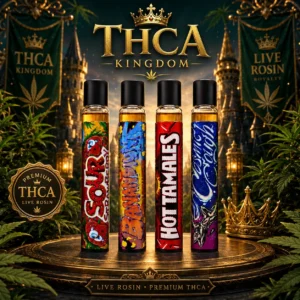
Live resin vapes are a category of cannabis-derived vaping products associated with live resin, a concentrate made from freshly harvested cannabis material that is preserved before conventional drying and curing. Live resin is often discussed because its production aims to retain more of the plant’s original aromatic compounds, including terpenes, alongside cannabinoids.
However, the term live resin vapes does not automatically guarantee a particular cannabinoid concentration, ingredient profile, manufacturing standard or level of safety. Products can differ significantly depending on their source material, extraction process, formulation and laboratory testing.
At THCa King Europe, readers can explore educational information about cannabinoids, concentrates and cannabis-derived products. This guide explains what live resin is, how it differs from distillate, why terpene profiles matter, what laboratory testing can reveal and which European regulatory considerations are important.
What Are Live Resin Vapes?
Live resin vapes are vaping products associated with live resin cannabis extract. Live resin is a type of cannabis concentrate generally produced from freshly harvested cannabis material that has been frozen rather than conventionally dried and cured before extraction.
The purpose of preserving fresh plant material is to retain more of its original aromatic compounds. These include terpenes, which contribute to the characteristic aroma of different cannabis varieties.
Live resin may also contain multiple cannabinoids, depending on the original plant material and extraction process.
It is important to distinguish between live resin as an extract and a finished vape product. A finished product may contain additional ingredients, and its composition cannot be established from the words “live resin” alone.
Readers interested in learning more about cannabis concentrates can explore the educational resources available through the THCa King Europe website and its blog section.
What Is Live Resin?
Live resin is a cannabis concentrate associated with the preservation of fresh plant compounds.
Unlike conventional dried cannabis material, the starting plant material for live resin is generally frozen soon after harvesting. This helps preserve volatile aromatic compounds that may otherwise change or degrade during drying and storage.
Live resin is commonly produced using solvent-based extraction methods. The resulting concentrate can have different textures, colours and cannabinoid profiles depending on the source material and production process.
Some important characteristics include:
- Fresh-frozen starting material: The plant material is preserved through freezing before extraction.
- Terpene profile: Live resin may retain a range of aromatic compounds from the original plant.
- Cannabinoid composition: The extract can contain THCA, THC and other cannabinoids, depending on the material and process.
- Batch variation: Different harvests and production methods can result in different chemical profiles.
- Concentrated composition: Live resin is an extract rather than ordinary dried cannabis flower.
A clinical framework for evaluating cannabis product quality describes live resin as a hydrocarbon extract made from fresh cannabis plant material. The framework also discusses why concentrate composition and quality deserve particular attention.
Reference: https://pmc.ncbi.nlm.nih.gov/articles/PMC10249738/
Why Are Terpenes Important in Live Resin?
Terpenes are naturally occurring aromatic compounds found in many plants, including cannabis. They contribute to the distinctive smells of different plant varieties.
Examples of commonly discussed cannabis terpenes include:
Myrcene
Myrcene occurs in several plants and is associated with earthy, herbal and musky aromatic characteristics.
Limonene
Limonene is found in citrus fruits and is associated with citrus-like aromas.
Pinene
Pinene is a terpene associated with pine-like aromas and is also found in many other plants.
Caryophyllene
Caryophyllene is associated with spicy, peppery and woody aromatic characteristics.
Linalool
Linalool is found in several aromatic plants and is associated with floral characteristics.
The presence and concentration of these compounds vary between cannabis varieties and individual batches.
Although terpenes contribute to aroma and flavour characteristics, their presence does not establish that a product is safe or medically beneficial. Their concentrations and composition should be supported by suitable analytical testing.
For more educational information about cannabis-derived products, visit THCa King Europe.
Live Resin Vapes vs Distillate Vapes
One common question about live resin vapes concerns how they differ from distillate-based products.
Both are associated with cannabis extracts, but their production methods and chemical profiles can differ.
Live resin
Live resin begins with fresh-frozen cannabis material. Its production aims to preserve more of the original plant’s terpene profile and other volatile compounds.
Its cannabinoid and terpene composition can vary between batches.
Distillate
Distillate is produced through additional refinement intended to isolate and concentrate particular cannabinoids.
This process generally removes many of the original plant compounds. Terpenes or flavouring ingredients may subsequently be added, depending on the finished product.
Understanding the differences
| Feature | Live resin | Distillate |
|---|---|---|
| Starting material | Commonly fresh-frozen cannabis | Cannabis extract or other cannabinoid-rich material |
| Processing | Extraction designed to retain more original plant compounds | Additional refinement and separation |
| Terpenes | May retain naturally occurring plant terpenes | Often reduced during refinement |
| Cannabinoids | Composition varies by batch | Often concentrated around selected cannabinoids |
| Product consistency | Depends on source material and processing | Depends on refinement and formulation |
Neither category should automatically be considered safer. A product’s actual ingredients, concentration, contaminants and manufacturing standards are more important than its marketing category.
For further information about concentrates, readers can explore the THCa King Europe blog.
What Cannabinoids May Be Found in Live Resin?
Cannabis extracts can contain several cannabinoids. Their concentrations depend on the plant variety, maturity, extraction process and finished formulation.
THCA
Tetrahydrocannabinolic acid (THCA) is an acidic cannabinoid precursor naturally associated with cannabis.
THCA is chemically different from Delta-9 THC. When exposed to heat, it can undergo decarboxylation and convert into Delta-9 THC.
Delta-9 THC
Delta-9 THC is a psychoactive cannabinoid that can affect perception, attention, coordination and memory.
CBD
Cannabidiol (CBD) is a different cannabinoid that is not generally associated with the same intoxicating effects as Delta-9 THC.
Minor cannabinoids
Other cannabinoids, such as CBG and CBN, may also be detected in cannabis-derived extracts.
The presence of any particular cannabinoid should be established through laboratory analysis rather than inferred from the name of a strain or product.
Why Laboratory Testing Matters for Live Resin Vapes
Laboratory testing is important when evaluating cannabis concentrates and finished vaping products.
A Certificate of Analysis (COA) provides analytical information about a tested sample. It can help establish the cannabinoid profile and identify certain contaminants, depending on the testing panel.
When reviewing a COA, the following areas deserve attention.
1. Cannabinoid profile
A cannabinoid analysis can identify compounds such as THCA, Delta-9 THC, CBD and other cannabinoids.
It is important to understand whether the report gives individual cannabinoid concentrations or a calculated total.
2. Terpene profile
A terpene analysis can identify aromatic compounds and report their measured concentrations.
This can help explain the chemical differences between individual batches.
3. Residual solvents
Some extraction processes use solvents. Appropriate testing can help determine whether residual solvent levels meet the relevant analytical or regulatory requirements.
4. Heavy metals
Heavy metals are another potential contaminant category that may be included in a laboratory testing programme.
5. Pesticides and microbial contamination
Depending on the product and testing panel, laboratory analysis may also screen for pesticide residues, bacteria, mould and other microbial contaminants.
6. Batch identification
A useful COA should identify the tested product or batch. A laboratory report from an unrelated sample does not necessarily establish the composition of the product being described.
The Illinois Department of Agriculture provides an accessible explanation of what a Certificate of Analysis can contain, including cannabinoid potency and screening for residual solvents, pesticides, heavy metals and microbial impurities.
Reference: https://cannabis.illinois.gov/agencies/cannabis-idoa/consumer-resources/understanding-a-coa.html
A laboratory report is useful evidence, but it does not guarantee that a finished inhalable product is harmless or suitable for every person.
Understanding the Potential Risks of Cannabis Vaping
Live resin vapes are associated with inhalation of cannabis-derived concentrates. Vaping should not be assumed to be risk-free simply because it does not involve conventional combustion.
The US Centers for Disease Control and Prevention (CDC) explains that cannabis oils and concentrates used in vaping may contain highly concentrated THC and can include additives or contaminants.
The CDC also notes that vaping has been linked to lung injury and that scientists do not have enough evidence to establish that one method of cannabis use is universally safer than another.
Potential concerns include:
- Exposure to unwanted substances in inhaled aerosols.
- Respiratory irritation and other lung-related concerns.
- Uncertain effects of some additives and flavouring ingredients.
- Intoxication from THC-containing products.
- Impaired memory, attention and coordination.
- Uncertainty about the long-term effects of cannabis vaping.
People should be especially cautious about products with unclear ingredient lists, missing laboratory reports or unsupported claims about safety.
Official CDC guidance:
https://www.cdc.gov/cannabis/faq/
Health Canada also provides information about cannabis vaping accessories, aerosol exposure and potential contaminants:
Can Live Resin Vapes Cause Intoxication?
Yes, products containing psychoactive cannabinoids such as Delta-9 THC can cause intoxication.
The effects may include changes in perception, mood, memory, concentration and coordination.
A product containing THCA may also have intoxicating potential when heated because THCA can convert into Delta-9 THC through decarboxylation.
The level of intoxication cannot be determined simply by looking at the product’s colour, texture, aroma or marketing description.
THC can impair driving ability and decision-making. Anyone affected by THC should not drive or operate machinery.
For additional information about THC and cannabis-related health effects, consult the CDC:
https://www.cdc.gov/cannabis/faq/
Are Live Resin Vapes Legal in Europe?
The legal status of live resin vapes is an important consideration for European consumers and businesses.
There is no universal rule that automatically permits every cannabis-derived vape product throughout Europe.
Different countries have different controlled-substance laws, and finished products may also be subject to additional national and EU requirements.
The European Union Drugs Agency (EUDA) explains that cannabis-derived products may fall under different legal frameworks depending on their composition, intended use and classification.
These frameworks may include controlled-substance legislation, medicinal-product regulations and rules governing commercial products.
The EUDA’s official guidance is available here:
https://www.euda.europa.eu/publications/faqs/cannabis-laws-in-europe-faq_en
Its information about medical and commercial cannabis-derived products is particularly relevant:
Do EU vaping regulations automatically authorise cannabis vapes?
No.
The European Commission explains that Article 20 of the Tobacco Products Directive establishes rules for electronic cigarettes sold as consumer products in the EU, including requirements concerning nicotine-containing products.
These rules should not be interpreted as general authorisation for THC-containing cannabis vape products.
The legal classification of a particular cannabis-derived product must be assessed separately under the relevant legislation.
Official European Commission information:
https://health.ec.europa.eu/tobacco/product-regulation/electronic-cigarettes_en
A product’s availability online or its description as hemp-derived does not prove that it is lawful to possess, sell, import or consume in every European country.
Always verify the current requirements in the specific country concerned.
How to Evaluate Live Resin Product Information
When researching live resin vapes, it is useful to look beyond advertising claims and examine the supporting information.
Consider these questions:
- Is the product clearly identified? The description should explain whether it is live resin, distillate or another type of concentrate.
- Is the cannabinoid composition documented? A relevant laboratory report should identify the measured cannabinoids.
- Is there a terpene analysis? Where available, this can help describe the product’s aromatic profile.
- Are contaminants addressed? Check which laboratory tests were performed rather than assuming every COA includes every possible test.
- Are ingredients transparent? Finished products should have clear ingredient information and appropriate warnings.
- Are the claims realistic? Be cautious of claims that a product is completely safe, guaranteed to produce a particular effect or suitable for treating medical conditions.
- Are the legal requirements understood? Check national rules before making assumptions about the legality of cannabis-derived products.
Readers looking for additional cannabinoid education can visit the THCa King Europe homepage or browse its blog section.
Frequently Asked Questions About Live Resin Vapes
1. What are live resin vapes?
Live resin vapes are vaping products associated with live resin cannabis extract. Live resin is generally produced from fresh-frozen cannabis material to retain more of the plant’s original aromatic compounds.
2. What makes live resin different from distillate?
Live resin aims to retain more of the original plant’s terpene profile, while distillate undergoes additional refinement to concentrate selected cannabinoids. Their compositions and manufacturing processes differ.
3. Why are terpenes important in live resin?
Terpenes are aromatic compounds that contribute to the characteristic scent of cannabis varieties. Their presence and concentrations can vary between live resin batches.
4. Does live resin contain THC?
Live resin may contain THCA, Delta-9 THC and other cannabinoids, depending on the starting material and production process. The actual composition should be established through laboratory analysis.
5. Can THCA become THC when heated?
Yes. THCA can convert into Delta-9 THC through decarboxylation when exposed to heat.
6. Are live resin vapes safe?
Vaping cannabis concentrates carries potential health risks. Aerosols may contain unwanted substances, and THC can cause impairment. A product label or laboratory report cannot guarantee that inhalation is risk-free.
7. What is a Certificate of Analysis?
A Certificate of Analysis is a laboratory report containing analytical results for a tested sample. It may include cannabinoid concentrations, terpene information and contaminant screening.
8. Are live resin vapes legal throughout Europe?
No blanket permission applies throughout Europe. Legal status depends on the country, product composition and applicable national and EU legislation.
9. Does a live resin label guarantee natural ingredients?
No. The term describes a type of cannabis extract and its production approach. It does not establish that every ingredient in a finished vape product is naturally derived or that the product is free from contaminants.
Conclusion: Understanding Live Resin Vapes
Live resin vapes are associated with a cannabis concentrate produced from fresh-frozen plant material. The process aims to preserve more of the plant’s original aromatic compounds, including terpenes, alongside cannabinoids.
However, the term live resin does not guarantee a particular level of quality, safety or cannabinoid concentration. Understanding the product requires attention to its ingredients, laboratory results, manufacturing standards and potential health risks.
European regulations also vary, so products should never be assumed to be lawful throughout the EU simply because they are described as hemp-derived or sold online.
At THCa King Europe, readers can continue exploring educational information about cannabinoids and cannabis-derived concentrates. Visit the THCa King Europe blog for more articles, or consult the website’s shop section for general product information.
Accurate descriptions, transparent documentation, responsible communication and compliance with applicable laws are essential when discussing live resin and other cannabis-derived products.