THCA vs CBD: 11 Important Differences Explained
THCA vs CBD — 11 Ultimate Differences
The sweeping expansion of the legal hemp industry throughout continental Europe has dramatically increased the demand for advanced consumer education. European wellness enthusiasts are no longer satisfied with generic, oversimplified labels. Instead, modern buyers dive deep into laboratory analysis matrices, exploring how individual plant compounds interact with the human body.
As you browse top-shelf indoor selections, boutique trim bags, or full-volume wholesale lots online, you will inevitably find yourself comparing two major chemical abbreviations: THCA vs CBD. While both molecules are celebrated compounds derived from the same botanical family, they operate in completely distinct realms of science, consumer experience, and raw performance.
To help you shop with absolute precision across the single market, this ultimate guide maps out the relationship of THCA vs CBD, highlighting 11 important differences that every savvy buyer must master.
Difference 1: Molecular Classification and Biological Origins
The fundamental baseline dividing THCA vs CBD traces directly back to their primary cellular structures within the living plant canopy. Tetrahydrocannabinolic Acid (THCA) is a raw, acidic cannabinoid synthesized inside the glandular trichome heads of the living plant. It is structurally classified as a carboxylated compound, meaning it possesses an attached chain of carbon dioxide.
Conversely, Cannabidiol (CBD) belongs to a entirely separate chemical branch. While it can exist in an acidic state (CBDA) inside a growing plant, the standard CBD found in e-commerce wellness catalogs is a fully neutral, decarboxylated molecule. When comparing the initial raw harvest profiles of THCA vs CBD, THCA serves as the direct maternal precursor to psychoactive Delta-9 THC, whereas CBD represents a highly stable, independent lifestyle compound that never mutates into a mind-altering structure.
Difference 2: The Core Mechanism of Psychoactivity
The single most practical division defining the THCA vs CBD consumer experience is how they alter or preserve your mental clarity. In its raw, unheated form, THCA is completely non-intoxicating. However, it is an inherently volatile molecule. The exact millisecond you introduce a heat source, its molecular shape transforms completely, turning it into active Delta-9 THC, which locks onto your brain’s internal pathways to induce a heavy, blissful cerebral high.
+--------------------------------------------------------------------------+
|                       PSYCHOACTIVE TRANSFORMATION PATHWAYS               |
+--------------------------------------------------------------------------+
|  RAW BASE STATE:       ---->   THERMAL ENERGY (180°C+):                  |
|  [THCA] (Non-Active)   ---->   Instant Decarboxylation to Active THC     |
|                                (Delivers Crushing Cerebral High)         |
|                                                                          |
|  [CBD]  (Non-Active)   ---->   Remains 100% Stable and Neutral           |
|                                (Zero Psychoactive Potential Ever)        |
+--------------------------------------------------------------------------+
When analyzing THCA vs CBD, CBD offers an entirely different consumer outcome. CBD is inherently non-psychoactive and completely non-intoxicating, regardless of whether it is consumed raw, baked into edibles, or subjected to extreme lighter flames. It is physically impossible for pure CBD to induce a traditional cannabis high. This structural stability makes it highly favored by daily professionals who demand pure functional support without any risk of altered mental perception.
Difference 3: Receptor Binding Affinity inside the Endocannabinoid System
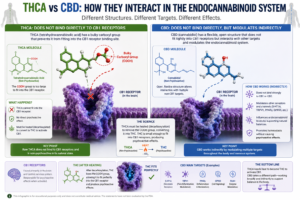
To master the true inner workings of THCA vs CBD, we must observe how these plant compounds interact with our internal biological networks. The human body contains an intricate regulatory system known as the endocannabinoid system (ECS), which features specialized CB1 receptors localized heavily inside the brain and central nervous system.
The bulky carboxyl acid ring attached to the raw THCA molecule creates a physical barrier. Because of this large chemical tail, raw THCA cannot bind directly or interlock cleanly with your internal CB1 docking stations. It passes through peripheral networks without triggering downstream neural changes.
When you evaluate the cellular behavior of THCA vs THC, or look at THCA vs CBD, CBD also chooses to bypass direct CB1 receptor binding—but for a completely different reason. CBD possesses a highly flexible, open molecular structure that works indirectly. It acts as an external modulator, gently influencing non-cannabinoid receptors, vanilloid channels, and internal enzyme systems to support natural homeostasis without locking onto the primary pathways that control cognitive impairment.
Difference 4: The Impact of Decarboxylation (Heat Sensitivity)
The bridge that connects raw plant matter to active potency is a heat-driven molecular reaction known throughout the agricultural world as decarboxylation. This thermal transition marks an essential dividing line in the THCA vs CBD comparison.
               [ Thermal Energy: 180°C - 210°C ]
    Raw THCA ──────────────────────────────────> Active Delta-9 THC
 (Acidic Precursor)                          (CO2 Released as Vapor)

    Pure CBD  ──────────────────────────────────> Remains Pure CBD
 (Stable Compound)                           (Zero Structural Change)
When raw THCA flower crosses specific thermal boundaries (typically between 180 and 210 degrees Celsius), the intense heat breaks its delicate chemical bonds, instantly releasing carbon dioxide ($CO_2$) gas and creating active THC.
CBD undergoes no such transformation when exposed to a lighter flame. Because it has already been stripped of its acidic properties during initial processing, heating a CBD flower bud simply vaporizes the existing compound cleanly without mutating its core chemical identity. Understanding how heat alters the state of THCA vs CBD is critical for selecting consumption methods that match your lifestyle goals.
Difference 5: Native Sourcing and Commercial Hemp Cultivation
Where do these compounds come from, and how are they cultivated inside the European marketplace? While both molecules can be extracted from industrial hemp crops, their presence across specific plant lineages highlights a clear operational contrast between THCA vs CBD.
Boutique boutique growers cultivate select high-THCA hemp canopies in immaculate, indoor cleanrooms, shielding the living plants from the elements to maximize resin-caked trichome production. These flowers are engineered to pack massive percentages of raw acidic precursors while strictly keeping active Delta-9 THC below legal thresholds.
In contrast, mass-market agricultural farms cultivate traditional CBD crops primarily across sprawling outdoor acreage or standard greenhouse setups. CBD dominant plants natively yield high volumes of stable cannabidiol across their entire leaf canopy, making them perfect for high-volume mechanical harvesting and industrial-scale oil extractions.
Difference 6: Bioavailability Rates and Internal Absorption Kinetics
How efficiently your body processes a cannabinoid determines how long it takes for effects to set in. This is why the absorption profiles of THCA vs CBD require distinct consumption approaches.
In its unheated, raw state, the large molecular size of the THCA molecule limits its overall bioavailability within the human digestive tract, meaning the raw body requires a longer window to filter and absorb the unheated acid.
CBD possesses far higher baseline stability and enhanced molecular absorption kinetics. Because it interacts seamlessly with fatty lipid carriers, manufacturing labs can easily blend CBD into rapid-acting nano-emulsions, sublingual tinctures, and specialized topical creams. This chemical flexibility enables CBD to enter systemic circulation swiftly, providing predictable and rapid functional relief that sets it apart in the THCA vs CBD landscape.
Difference 7: Product Diversity and Marketplace Availability
Walk into any major digital dispensary or wellness boutique across Europe, and the sheer variety of product listings will quickly reveal a structural imbalance between THCA vs CBD. Because CBD has enjoyed decades of mainstream acceptance and chemical stability, it dominates an incredibly diverse product marketplace. You can buy CBD infused into bath bombs, specialized athletic topicals, infused gummies, softgel capsules, and broad-spectrum skincare oils.
+-----------------------------------------------------------------------+
|                       MARKETPLACE PRODUCT MATRICES                    |
+-----------------------------------------------------------------------+
| THCA DISPENSARY ROTATION: | Raw Caked Flowers, Concentrates, Pre-Rolls|
|                           | (Geared toward authentic rolling rituals) |
|                                                                       |
| CBD LIFESTYLE ROTATION:   | Tinctures, Edibles, Skincare, Topicals    |
|                           | (Geared toward seamless daily routines)   |
+-----------------------------------------------------------------------+
When you examine the current market for THCA vs CBD, THCA remains focused primarily on traditional raw flower form, premium pre-rolled cones, and highly potent concentrates like live diamonds or solventless rosins. This concentrated selection exists because true connoisseurs look for THCA to recreate an authentic smoking or vaporizing ritual, relying on direct thermal activation at the exact moment of consumption.
Difference 8: Workplace Drug Testing Implications
For many daily consumers across the European workforce, protecting your professional career while using natural plant supplements is a high-priority concern. This reality creates a massive, critical divide between THCA vs CBD.
Standard commercial drug tests do not screen for raw, unheated THCA or stable CBD. Instead, they look almost exclusively for a secondary metabolite known as THC-COOH, which the liver produces after processing active Delta-9 THC.
Because utilizing heat instantly converts raw THCA into active THC, smoking or vaping a high-THCA indoor cultivar will absolutely trigger a positive workplace screening result. Conversely, checking out with pure, certified CBD isolates or broad-spectrum formulations guarantees an entirely clear profile, as these items contain zero active THC and will not trigger a positive drug screening result.
Difference 9: Long-Term Storage and Chemical Stability
How long a botanical inventory maintains its peak freshness determines its true overall value for end consumers. This degradation process represents another core difference when analyzing THCA vs CBD.
THCA is a highly volatile, chemically sensitive cannabinoid. If raw flower is left exposed to direct sunlight, high ambient room temperatures, or excess oxygen currents over a long period, it will naturally degrade and slow-decarb into active Delta-9 THC on its own, potentially throwing off legal compliance metrics.
CBD is a highly rugged, resilient molecule. It resists degradation from light and heat over extended storage windows, allowing retail shops and bulk processors to safely stock large volumes without worrying about unpredictable molecular shifts.
Difference 10: Therapeutic Profiles and Targeted Wellness Applications
While premium vendors prioritize customer care and make no definitive medical claims, reviewing user reviews and emerging studies reveals that THCA vs CBD offer highly distinct natural lifestyle support profiles.
Because raw flower preserves the plant’s native acidic compounds, consumers who choose THCA often seek out its unique, raw properties for intense anti-inflammatory support, neuroprotective potential, and system decompression after exhausting physical shifts.
CBD has a much broader, well-documented clinical research history. It is highly sought after across Europe as an everyday tool for targeted stress management, calming rapid thoughts, easing muscle stiffness, and promoting deeper, more restorative sleep cycles. Looking closely at THCA vs CBD ensures you select the perfect molecule to match your body’s wellness goals.
Difference 11: Cross-Border European Legality and EUDA Guidelines
The final, most complex difference between THCA vs CBD governs how these items are legally transported through commercial mail networks across European borders. Under current regulations, industrial hemp products are legally distinguished from restricted substances by looking at their dry-weight percentage of active Delta-9 THC, which must remain strictly below the region’s mandatory 0.3% threshold.
+-----------------------------------------------------------------------+
|                    EUROPEAN UNION COMPLIANCE SUMMARY                  |
+-----------------------------------------------------------------------+
| MAX DELTA-9 THC REGULATION:    | 0.3% Dry-Weight Compliance Limit     |
| REQUIRED DOCUMENTATION:        | 3rd-Party Certificate of Analysis    |
| MONITORED BY:                  | European Union Drugs Agency (EUDA)    |
+-----------------------------------------------------------------------+
Because unheated boutique flower natively isolates its active Delta-9 THC safely under the 0.3% limit, it perfectly aligns with industrial logistics standards. However, because it can mutate into THC when heated, certain regional jurisdictions impose specific local transport checks.
CBD enjoys a completely uniform, highly protected legal status across virtually every corner of the single market, as it carries zero psychoactive risk. For full overviews regarding active cross-border logistics policies, international transport mandates, and technical definitions for raw cannabinoid derivatives, consumers can review the official frameworks managed directly by the European Union Drugs Agency (EUDA). Reviewing official guidelines clarifies why monitoring the balance of THCA vs CBD is so essential for safe, long-distance shopping.
Smart Shopping Guidelines: Finding Top-Shelf Flower Batches
As consumer demand for authentic plant choices reaches record heights, learning to spot the difference between premium, hand-trimmed boutique crops and low-tier industrial biomass is an essential skill. Cheap, unverified vendors frequently distribute poorly dried outdoor industrial hemp caked in harsh chemical fertilizer residues and heavy metals that ruin the flavor and irritate your respiratory tract.
+-----------------------------------------------------------------------+
|                         THE CONNOISSEUR'S CHECKLIST                   |
+-----------------------------------------------------------------------+
| 1. Full Transparency: | Verifiable, QR-coded third-party CoA sheets.   |
| 2. Immaculate Trim:   | Tight, hand-manicured buds free from leaf mass.|
| 3. Loud Terpene Scent:| Intense, immediate aroma of gas, fruit, or pine.|
+-----------------------------------------------------------------------+
When you evaluate the data behind THCA vs CBD, remember that getting top-shelf bag appeal does not require paying excessive markup fees. Smart buyers looking for an exceptional, all-around daily introduction to raw flower potency can explore our well-balanced] /product/budget-buds-thca-flower/] line, or experience true luxury by checking out the ultra-sweet, frosted attributes of our premium /product/pink-runtz-exotic-thca/] selections to begin their rotation with true royal standards.
Secure, Smell-Proof Shipping Across the Entire European Market
The final piece of the puzzle is ensuring a smooth, secure checkout experience. Top-tier providers recognize that absolute discretion is non-negotiable when ordering limited-edition lifestyle flowers online.
At THCA King, every single package is shipped using specialized, multi-layered, completely smell-proof vacuum seals hidden within entirely unbranded, durable cardboard boxes. Your parcel moves swiftly from automated fulfillment hubs straight to your destination address within 2 to 3 business days, completely hassle-free. By mastering the core science behind THCA vs CBD, you take full control of your shopping journey. Treat yourself like royalty and elevate your collection today!